


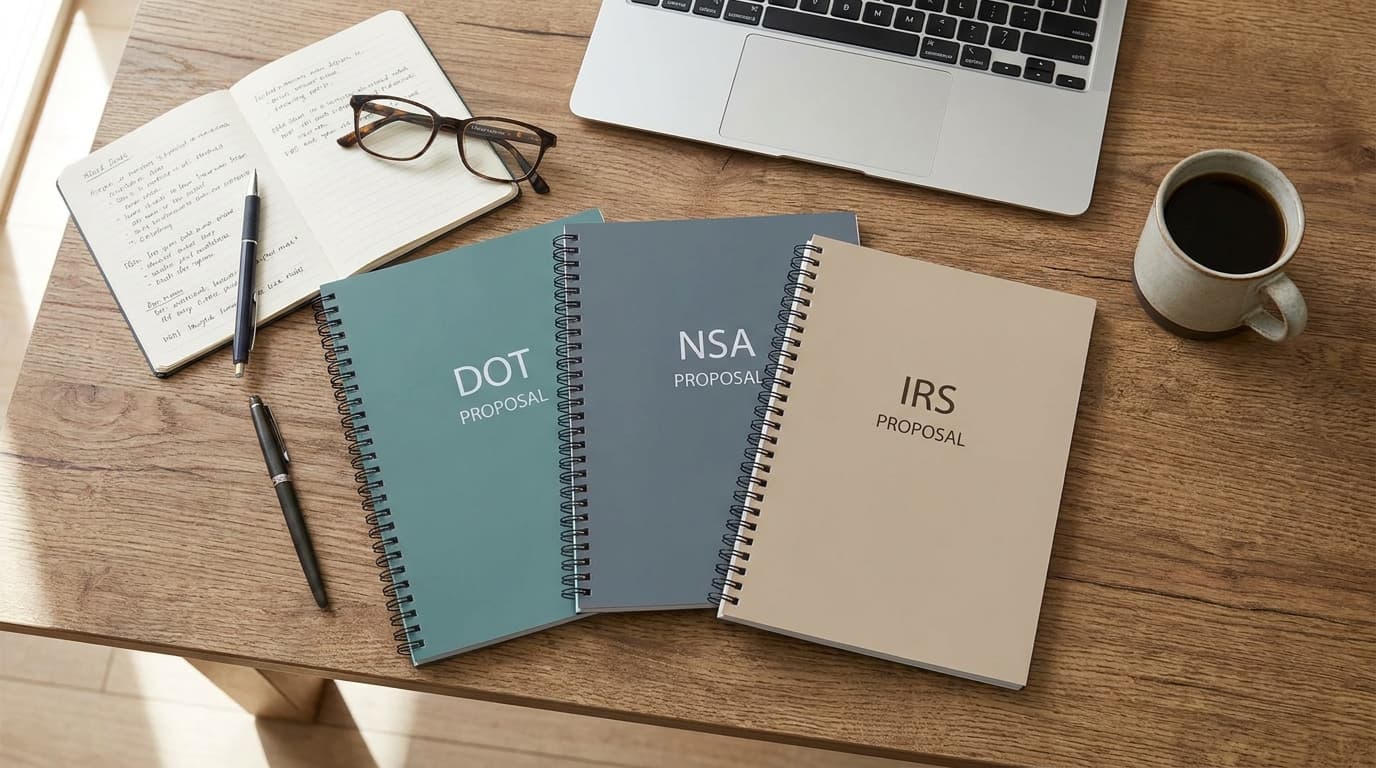
Federal Acquisition Regulation (FAR) Subpart 15.6 has long represented the ultimate high-risk, high-reward backdoor into federal procurement. Decades of Government Accountability Office (GAO) bid protests, such as the precedent-setting Halifax Corporation ruling, have cemented a hard truth about this acquisition avenue. Agencies will aggressively reject unsolicited proposals that even slightly resemble a known, upcoming requirement or fail to demonstrate genuine independent innovation.
Despite the rigid statutory guardrails, unsolicited proposals remain one of the most powerful mechanisms for contractors to shape an agency’s acquisition strategy before an RFP is ever conceived. It allows vendors to introduce disruptive technology, secure sole-source awards, and pivot an agency's technical roadmap toward their proprietary solutions.
Yet, the nuances of submitting these proposals trip up even seasoned business development teams. The FAR provides the overarching framework, but the localized routing rules, formatting strictures, and evaluation thresholds vary wildly from one civilian or defense agency to the next. What constitutes a valid submission for a highly classified intelligence mission looks entirely different from a civilian infrastructure pitch.
To capture sole-source revenue successfully, your capture team needs a precise agency unsolicited proposal guide that maps the overarching federal statutes to the localized demands of specific target agencies.
TL;DR: Navigating Unsolicited Proposals
While FAR 15.6 sets the baseline rules for unsolicited proposals, successful submissions require deep agency-specific tailoring. The NSA demands strict adherence to security protocols via the ARC, the DOT requires alignment with precise operating administrations (like the FAA or FHWA), and the IRS prioritizes solutions that advance their Enterprise Digitalization initiatives.
Bottom line: A winning unsolicited proposal must be independently originated, highly innovative, and mapped directly to an agency's strategic pain points without acting as an advance bid for a known requirement.
What You'll Learn In This Guide
- The foundational FAR 15.6 rules governing all unsolicited federal submissions.
- How to navigate the NSA's Acquisition Resource Center (ARC) and security requirements.
- Methods for targeting the correct DOT operating administration for infrastructure pitches.
- Strategies for aligning your proposal with the IRS's aggressive modernization goals.
- Best practices for pre-submission networking and avoiding automatic rejections.
Your Agency Unsolicited Proposal Guide: Understanding The Basics
An unsolicited proposal is a written offering submitted to a federal agency on the initiative of the offeror, designed to secure a contract without a formal solicitation. Unlike responding to a Request for Proposal (RFP) or a Broad Agency Announcement (BAA), an unsolicited proposal requires your team to proactively identify a problem the agency may not even realize it has—and present a fully baked solution.
Because you are operating outside the standard competitive acquisition timeline, this mechanism is a highly valuable tool for BD professionals. It allows you to circumvent crowded recompete cycles, shape future requirements, and position your firm for sole-source justification under FAR 6.302-1 (only one responsible source).
However, all federal agencies are bound by FAR Subpart 15.6, which strictly defines what an agency can accept. The government cannot use your submission as a workaround to avoid competition for standard commercial goods or services. To deeply understand the regulatory baseline before diving into agency-specific nuances, read our comprehensive FAR 15.6 explained contractor's guide to unsolicited proposals.
Key Characteristics Of A Valid Submission
To survive the initial screening phase at any federal agency, your submission must meet the strict definition outlined in FAR 15.603(c). If your BD team fails to check these boxes, the agency's procurement office will return the document without further technical evaluation.
- It must be innovative and unique: Your concept cannot be a generic commercial service or a widely available product. It must demonstrate a proprietary process, a novel technological application, or a highly specialized methodology.
- It must be independently originated: The idea must come entirely from your team. If an agency official requested the proposal, or if it stems from ongoing dialogue where the government heavily influenced the solution, it is no longer "unsolicited."
- It cannot be an advance proposal: If the agency has already published an RFI, Sources Sought, or draft RFP on SAM.gov for this exact requirement, your submission will be rejected as an attempt to bypass the competitive process.
- It must include detailed cost and technical data: A simple marketing slick or capability statement is not an unsolicited proposal. You must provide enough substantive detail for an agency subject matter expert (SME) to evaluate its feasibility and cost realism.
National Security Agency (NSA): Meeting Intelligence And Security Needs
Selling to the Intelligence Community (IC) presents an entirely different set of hurdles than the civilian market. The National Security Agency (NSA) constantly seeks advanced technologies to maintain signals intelligence (SIGINT) superiority and defend national security systems.
The NSA's focus areas for unsolicited proposals naturally revolve around high-stakes technical domains. They are particularly interested in next-generation cybersecurity solutions, quantum-resistant cryptography, advanced computing technologies, artificial intelligence for massive data set analysis, and novel SIGINT collection methodologies.
However, submitting to the NSA requires strict adherence to their unique intake process. All vendors must be registered in the NSA Acquisition Resource Center (ARC). The ARC serves as the primary gateway for industry to communicate with the agency. Attempting to bypass the ARC by directly emailing an NSA contracting officer with a technical white paper will likely result in an immediate dead end.
Security clearances heavily dictate how you can frame your proposal. If your solution relies on classified data or addresses a classified capability gap, your BD team must ensure the proposal is transmitted via secure, approved channels (e.g., SIPRNet, JWICS, or an authorized SCIF). Spillage of classified information into unclassified ARC portals is a severe violation that will immediately disqualify your firm.
Structuring Technical And Cost Sections
The NSA applies a notoriously rigid preliminary review standard. To ensure your proposal makes it to the technical SMEs without triggering a procedural rejection, you must bifurcate your technical and cost sections meticulously.
Your technical volume must clearly separate the overarching scientific or operational concept from your proprietary implementation. The NSA needs to evaluate the core math or computer science behind your cybersecurity tool independently of your specific software architecture.
In the cost section, the NSA requires a granular breakdown of labor categories, material costs, and any required government-furnished equipment (GFE). Because much of the NSA's work occurs in secure facilities, you must explicitly detail the security clearance status of your proposed personnel and whether you require NSA facility access to execute the proposed work. Ambiguity regarding clearance requirements will halt the evaluation process.
Department Of Transportation (DOT): Solving Infrastructure Challenges
The Department of Transportation (DOT) manages a sprawling portfolio of infrastructure, aviation, and highway initiatives. Their unsolicited proposal process is heavily decentralized, meaning a generic pitch to the DOT headquarters is rarely effective.
The DOT’s current modernization priorities are heavily aligned with the Bipartisan Infrastructure Law. They are actively seeking proposals that address transportation safety (such as predictive crash analytics), green infrastructure (EV charging networks and sustainable paving materials), and mobility innovation (autonomous vehicle integration and smart traffic management grids).
To succeed here, your BD team must identify the correct DOT operating administration (OA). The Federal Aviation Administration (FAA), the Federal Highway Administration (FHWA), and the Federal Transit Administration (FTA) all maintain independent procurement offices with distinct strategic goals. A proposal aimed at optimizing drone air traffic control must be tailored exclusively to the FAA's focal point, referencing their specific operational frameworks like NextGen.
Pro Tip for DOT Submissions:
The FAA operates under its own Acquisition Management System (AMS), which differs significantly from the FAR. If you are submitting an unsolicited proposal specifically to the FAA, ensure your contract managers format the submission according to AMS guidelines, not standard FAR 15.6 rules.
When submitting to the broader DOT (excluding the FAA), procurement offices demand strict adherence to specific formatting and delivery instructions. While each OA may have minor variations, standardizing your approach ensures compliance.
- Cover Page Requirements: Must explicitly include the phrase "Unsolicited Proposal," your company's unique entity identifier (UEI), CAGE code, and the names of personnel authorized to negotiate the contract.
- Page Limits: Many DOT operating administrations enforce a strict 25-page limit for the core technical volume. Appendices and cost data are typically excluded from this count but should remain concise.
- Marking of Proprietary Data: The DOT requires restrictive legends on the title page and on every subsequent page that contains trade secrets. Failure to use the exact verbiage outlined in FAR 15.609 will result in a loss of data protection.
- Delivery Mechanism: Most DOT OAs now require submission via designated procurement email boxes or specific federal portals, strictly prohibiting hard-copy binders unless specifically requested for physical prototypes.
Internal Revenue Service (IRS): Innovating Tax Administration
The Internal Revenue Service (IRS) is currently undergoing one of the most aggressive technological transformations in the federal government. Backed by multi-year funding from the Inflation Reduction Act, the agency is highly motivated to replace its legacy infrastructure.
Unsolicited proposals are a vital component of this modernization effort, particularly those directed toward the IRS Enterprise Digitalization and Case Management Office (EDCMO). The EDCMO is tasked with eliminating paper-based processes, migrating legacy COBOL systems to modern cloud architectures, and implementing advanced data analytics to detect tax fraud.
The IRS employs a rigorous, multi-stage review process for unsolicited submissions. Initially, the Office of Procurement Operations (OPO) conducts a compliance screening to ensure the proposal meets all FAR 15.6 criteria and includes a comprehensive cost estimate. If the proposal passes this administrative gate, it is forwarded to the relevant program office—such as IT or EDCMO—for a detailed technical evaluation by subject matter experts.
This SME evaluation is highly critical. The IRS evaluators will scrutinize your proposal to determine if the technology is truly independent and if it offers a measurable ROI compared to their existing modernization roadmap.
Aligning With IRS Strategic Goals
To capture the attention of IRS technical evaluators, your proposal must explicitly anchor itself to the agency's published strategic objectives. A brilliant software tool will be ignored if the IRS cannot see how it directly impacts their core mission areas.
First, focus on improving the taxpayer experience. Proposals that offer secure, seamless omnichannel communication or predictive customer service models align perfectly with the IRS's mandate to make tax compliance easier for citizens.
Second, prioritize data security and zero-trust architectures. The IRS houses some of the most sensitive financial data in the world. Any proposed digitalization or cloud migration tool must demonstrate airtight compliance with FedRAMP standards and IRS-specific security protocols.
Finally, emphasize operational efficiency. Whether you are proposing AI-driven document extraction or automated workflow routing, explicitly calculate how your solution reduces manual processing hours, accelerates case resolution, and allows IRS agents to focus on high-value enforcement tasks.
Best Practices For A Winning Unsolicited Proposal Strategy
Submitting an unsolicited proposal is resource-intensive. To maximize your capture budget and improve your win probability, your BD team must treat these submissions with the same strategic rigor as a top-tier RFP response.
The first rule of unsolicited proposals is that they should rarely be a complete surprise to the agency. While the document itself cannot be requested by the government, your BD team should have already established strong familiarity with the agency's leadership, pain points, and strategic plans.
To build a repeatable, highly structured process across your entire capture team, we highly recommend utilizing our how to write an unsolicited proposal for a federal agency template. This ensures every submission maintains a uniform standard of quality regardless of the target agency.
Pre-Submission Networking
Effective pre-submission networking is the hallmark of top-performing BD professionals. Before drafting a 30-page unsolicited proposal, engage in targeted agency outreach.
Request capability briefings with agency program managers or attend industry days to ask probing questions about their current technological bottlenecks. The goal of these conversations is not to pitch your specific unsolicited proposal—doing so could taint the "unsolicited" nature of the submission.
Instead, use these interactions to gather vital intelligence. Understand the agency's budget cycle, their frustration with incumbent systems, and their appetite for risk. By the time you formally submit your proposal, the agency SMEs should recognize your company name and associate it with deep domain expertise, ensuring your submission receives a thorough and enthusiastic review.
Unsolicited Proposal Do's And Don'ts Checklist
Before you hit send on any unsolicited proposal to the NSA, DOT, or IRS, run your final document through this rapid checklist to avoid the most common procedural pitfalls.
The Pre-Submission Checklist
✓ DO THIS:
- Mark proprietary data with exact FAR 15.609 legends.
- Include a realistic, fully burdened cost estimate.
- Target a specific program office or operating administration.
- Identify the period of time for which the proposal is valid (typically 6 months).
✗ DON'T DO THIS:
- Submit a generic marketing brochure or capability statement.
- Pitch a solution for a requirement already listed on SAM.gov.
- Send classified concepts through unclassified intake portals.
- Forget to include the names and contact info of authorized negotiators.
Frequently Asked Questions (FAQ)
How long does it take an agency to review an unsolicited proposal?
The review timeline varies drastically depending on the agency's workload and the complexity of your technology. The initial administrative screening by the procurement office usually takes between 15 to 30 days.
If your proposal passes the initial gate, the comprehensive technical evaluation by subject matter experts can take anywhere from three to six months. Highly classified NSA proposals or complex DOT infrastructure concepts may take even longer due to the coordination required across multiple directorates.
Can I submit the same unsolicited proposal to the NSA, DOT, and IRS simultaneously?
Technically, yes, but strategically, it is a poor decision. If a proposal is broad enough to apply equally to the NSA's SIGINT mission, the DOT's highway safety goals, and the IRS's taxpayer modernization efforts, it is almost certainly a commercial off-the-shelf (COTS) product.
Agencies reject COTS products submitted as unsolicited proposals because they lack the required uniqueness and innovation. You must highly customize the use cases, architectures, and cost models for each specific agency.
Will the agency fund my unsolicited proposal immediately?
No. Even if an agency enthusiastically approves your technical concept and deems it highly innovative, they must still locate the appropriate funding within their current budget cycle.
If the agency does not have discretionary funds readily available, they may have to request the budget in the next fiscal year. Furthermore, the contracting officer must still draft a Justification and Approval (J&A) document to award the contract on a sole-source basis, a process that requires internal legal and administrative review.
Accelerate Your Proposal Management With Craxy AI
Navigating the fragmented rules of an agency unsolicited proposal guide requires meticulous organization. When your BD team is juggling ARC registrations for the NSA, AMS compliance for the FAA, and FedRAMP documentation for the IRS, relying on scattered network drives and disconnected email threads is a recipe for compliance failure.
Craxy AI is designed specifically for high-performing federal BD teams. Our platform allows you to centralize your entire capture pipeline, ensuring that the rigid formatting guidelines for FAR 15.6 submissions are automatically tracked and enforced.
With Craxy AI, your proposal managers can securely store proprietary technical architectures, instantly reuse compliant cost narratives, and monitor the real-time status of submissions across multiple civilian and defense agencies in a single, unified dashboard. You no longer have to guess whether your team included the correct proprietary data legends—the platform safeguards your content and standardizes your output.
Ready To Stop Leaving Sole-Source Revenue On The Table?
Automate Your Multi-Agency Proposal Pipeline Today
Don't let complex agency regulations stall your best innovations. Centralize your guidelines, reuse winning technical content, and accelerate your submission process with Craxy AI's purpose-built proposal management suite.
Start Your Free TrialOpen RFPs you can bid on right now
Browse all- Telecommunication ServicesValhalla, New York · New York · Due Oct 5
- Water Works Electrical Improvements ServicesEl Paso, Texas · Texas · Due Oct 14
- Drug Enforcement Course Surveillance ServicesMeridian, Mississippi · Mississippi · Due Sep 25
- Enhancing Teacher Responsiveness ServicesTrenton, New Jersey · New Jersey · Due Oct 6
- Design and Build ServicesSpartanburg, SC.  · South Carolina · Due Sep 29
- Construction Manager at Risk ServicesBelton, Texas · Texas · Due Oct 6